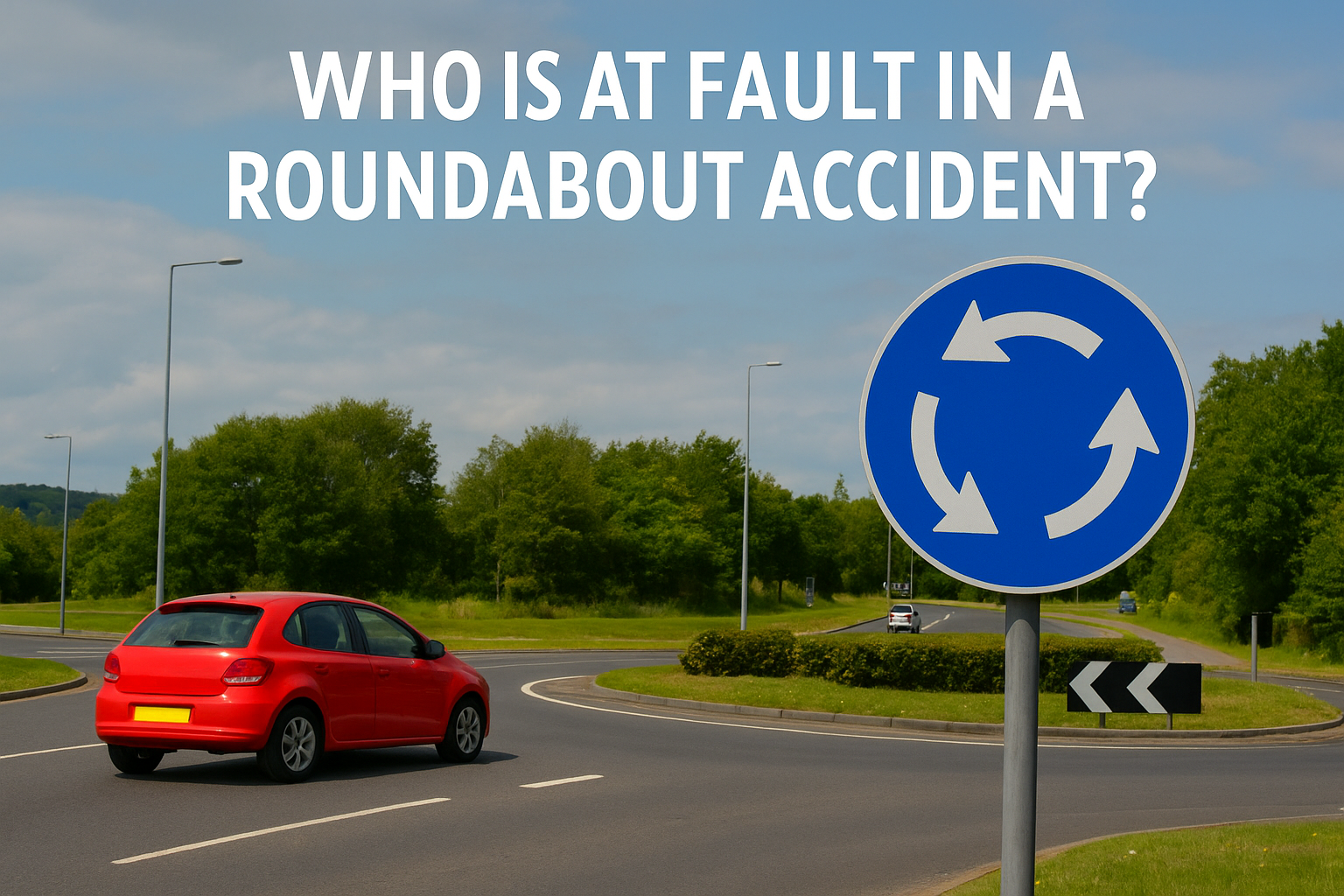

Roundabout Accidents in Northern Ireland. Who is at Fault?


Roundabouts keep traffic moving but they are also a common scene for collisions. Working out who is at fault in a roundabout accident can be complicated. Fault usually turns on who had right of way, who signalled correctly and whether any driver changed lanes or entered unsafely.

At Lacey Solicitors, we help innocent drivers, passengers, insurers, cyclists and pedestrians across Ireland and Northern Ireland resolve roundabout accident claims and assist in determining liabilty.


How Roundabouts Work


The Golden rule is always: traffic already on the roundabout has priority. Drivers entering must give way to vehicles approaching from the right. Both the Rules of the Road (Ireland) and Official Highway Code (Northern Ireland) require motorists to:

  • Give way to the right.
  • Use the correct lane for their intended exit.
  • Signal left when leaving.
  • Avoid sudden lane changes or cutting across traffic.

Common Causes of Roundabout Accidents in NI


  • Failing to yield to circulating traffic.
  • Entering or exiting from the wrong lane.
  • Changing lanes suddenly.
  • Not indicating correctly.
  • Tailgating or harsh braking.
  • Speeding or wet-weather skids.
  • Driver distraction.

Typical Fault Scenarios


1. Entering without giving way:
A driver who joins and collides with a vehicle already on the roundabout is normally at fault.

2. Lane discipline errors:
Drivers who cut across lanes or exit from the wrong lane may be fully or at least partially liable if an accident occurs.

3. Failure to signal:
Not indicating if it contributes to a collision can result in a driver being held to a degree liable for the accident.

4. Rear-end impacts:
Usually the rear driver will be found at fault.

5. Collisions with cyclists or motorcyclists:
These vulnerable road users should be afforded strong legal protection due to their increased risk of serious injury.  It is vital that you take care and look for cyclists and motorcyclists.


Proving Fault in Roundabout Accidents


Detailed documentation can help establish fault, clarify the circumstances of the accident, and protect your legal rights. Useful evidence includes:

  • Dashcam or CCTV footage.
  • Witness statements.
  • Garda or PSNI reports.
  • Photographs of vehicle positions and damage.
  • Time-stamped messages or insurer correspondence.

Shared Responsibility


Whether it is Sandyknowes Roundabout Glengormley or Caw Roundabout in Derry, an inescapable truth is that in many roundabout accidents, fault is often shared between the drivers.

Liability is often be apportioned where both parties contributed to the collision, perhaps through poor observation, incorrect lane use, or failure to signal properly. This legal principle, known as contributory negligence, can reduce the amount of compensation awarded to reflect each driver’s degree of responsibility.

For example, where both drivers contributed equally to the accident, your compensation might be reduced by 50%.

Useful evidence like the evidence outlined above is critical to assisting your car accident solicitor in proving the other driver is at fault.


What to Do After a Roundabout Accident


  1. Ensure everyone is safe.
  2. Exchange driver and insurance details.
  3. Take photos of the scene if it is safe to do so.
  4. Report serious incidents to Gardaí or PSNI.
  5. Seek legal advice before speaking to insurers.

How Lacey Solicitors Can Help


With offices in Dublin and Belfast, Lacey Solicitors represent clients in all types of road traffic accident claims, including complex liability disputes arising from roundabout collisions.

Our experienced team can:

  • Investigate fault and liability using expert accident reconstruction and evidence analysis.

  • Engage directly with insurers and third parties to progress your claim efficiently.

  • Pursue full compensation for your injuries, vehicle damage, loss of earnings, and related expenses.

We provide clear, practical legal advice and ensure that every client receives a personal, professional, and transparent service from start to finish.

Lacey Solicitors Belfast & Dublin : The Implications of Farley v Equiniti for Data Protection and Data Breach Claims


At Lacey Solicitors, with offices in Belfast and Dublin, our data protection solicitors represent clients affected by high-profile data breaches across the entire island of Ireland. The Court of Appeal ruling in Farley and Others v Paymaster (1836) Limited (trading as Equiniti) [2025] EWCA Civ 1117 has solidified the approach to compensation for data protection breaches in the UK – a development highly relevant for both clients and organisations seeking guidance from expert data protection solicitors on the issue of a data breach.

The focus of the Court of Appeal was the confirmation that there is no minimum threshold of harm for claims under Article 82 of the UK GDPR or section 168 of the Data Protection Act 2018 (DPA 2018).

A claimant can therefore seek compensation for a minor claim of distress or fear of misuse of personal data.


What Happened in Farley


The case arose after Equiniti, administrator of the Sussex Police pension scheme, accidentally sent over 750 annual benefit statements to outdated addresses. These statements contained sensitive information including names, dates of birth, National Insurance numbers, salaries, and pension entitlements.

Following the breach, a claim form was issued on behalf of 474 current and former officers, seeking damages for breach of statutory duty under the UK GDPR and the DPA and/or misuse of private informationarising from the [respondent’s] failure to keep the claimants’ personal data and private information secure by posting the same to incorrect postal addresses.


The High Court Decision


At first instance, Mr Justice Nicklin struck out most claims, leaving only fourteen claimants whose letters had been physically opened. Only two could show that someone outside their family or workplace had actually read the documents.

The High Court applied a “de minimis” principle, dismissing claims that weren’t considered sufficiently serious. The court concluded that the mere risk of disclosure—without evidence that the information had been seen—was not enough to support compensation.


The Court of Appeal


The Court of Appeal overturned much of the High Court’s decision, clarifying several important principles relevant for individuals consulting data protection solicitors:

  • Proof of disclosure is not required: Data does not need to have been accessed by a third party for processing or an infringement to occur. The term “processing” covers all steps, including collating, printing, and sending letters.
  • Distress is not essential: Non-material damage can be claimed even without proving distress, though compensation does not cover every emotional reaction to a breach.
  • No threshold of seriousness: Claims under the GDPR do not require a minimum level of harm.
  • Fear of misuse must be well-founded: Where claims are based on fear that personal data could be misused by third parties, the fear must be objectively reasonable, based on what the claimant knew or should have known at the time.
  • Future harm is compensable: A claimant may have a well-founded fear of future misuse, even if no actual harm occurs.

These findings emphasise that data protection claims focus on the unlawful processing of personal data, rather than solely on whether actual harm or disclosure occurred.


The Irish Supreme Court in Dillon v Irish Life


In a previous article, our office highlighted the Irish Supreme Court Decision in Dillon v Irish Life Assurance.  This Decision was referenced by the English Court of Appeal who acknowledge that victims of data breaches who seek compensation “solely for mental distress, upset and anxiety … cannot expect anything other than very, very modest awards”

But the English Court of Appeal went on to say that some of the claims in the case encompass psychiatric injury and the modest scale of the likely recovery cannot of itself be sufficient to justify dismissal of the claim.

The Judge referenced Lewison LJ  Sullivan v Bristol Film Studios [2012] EWCA Civ 570, [2012] EMLR 27, [29]:The mere fact that a claim is small should not automatically result in the court refusing to hear it at all. If I am entitled to recover a debt of £50 …. it would be an affront to justice if my claim were simply struck out.”


Data Protection Breach or Misuse of Private Information


At Lacey Solicitors, one of the key distinctions that we often have to make clear to our client’s is the difference between Data Breach Claims and Misuse of Private Information Claims.  Both are, in our opinion erroneously, used interchangeably.

What Is a Misuse of Private Information Claim?


A misuse of private information claim is a common law tort that has evolved in light of Article 8 of the Human Rights Act 1998, which protects the right to respect for private and family life.  It arises when private information is disclosed without consent, even if data protection laws are not breached. Key elements include:

  • Expectation of Privacy: The information must be private, and the individual must reasonably expect it to remain confidential.
  • Unauthorised Disclosure: The information must be shared without consent.
  • Harm or Distress: The disclosure must cause harm or distress.


How It Differs from a Data Protection Breach


  • Legal Basis: Data protection breaches are statutory claims under UK GDPR and DPA 2018; misuse of private information claims are common law.
  • Scope: Data protection claims cover lawful handling of personal data, including collection, storage, and sharing. Misuse of private information focuses on unauthorised disclosure.

What You Should Know About Data Protection Breaches in Northern Ireland & Ireland


For individuals, the decision is significant: even minor breaches can entitle them to compensation for distress or fear of misuse.

For organisations, the implications are clear: even small errors in handling personal data carry liability. Businesses should consult data protection solicitors to ensure robust data governance, clear processes, and effective breach communication.

At Lacey Solicitors, we advise clients on risk management, compliance, and breach response, and represent individuals affected by high-profile data breaches across the entire Island of Ireland.


Conclusion


Farley v Equiniti strengthens the rights of individuals affected by data breaches. By removing the de minimis threshold, the Court confirmed that fear of misuse and emotional distress are valid grounds for compensation, even without actual disclosure.

For organisations, the judgment highlights the importance of compliance and proactive breach management. For individuals, it demonstrates that personal data rights carry real legal protections.

At Lacey Solicitors, as experienced data protection solicitors, we continue to represent clients in high-profile data breach claims, helping them secure compensation and protections under the law. Cases such as Farley, Lloyd v Google [2021] UKSC 50, Prismall v Google UK Ltd [2024] EWCA Civ 1516, and Rolfe v Veale Wasbrough Vizards Ltd [2021] EWHC 2809 (QB) form a strong foundation for our work in this area.

Will Writing in Belfast – Lacey Solicitors Partner with Cancer Research UK


If you’re considering will writing in Belfast, Lacey Solicitors can help you secure your family’s future with professional, simple, and stress-free services. We’re proud to announce that we are now a trusted legal partner of Cancer Research UK, making it easier than ever to write or update your Will.


Simple Will Writing Made Easy in Belfast


Writing a Will is one of the most important steps you can take to protect your loved ones and ensure your wishes are carried out. Our experienced solicitors in Belfast provide clear guidance throughout the process, helping you prepare a simple Will efficiently and professionally.

As part of our partnership with Cancer Research UK, once your Will is completed, Lacey Solicitors will invoice Cancer Research UK directly up to a fixed fee. This means you can write your Will at no direct cost to you, while still having the opportunity to leave a legacy gift that supports life-saving cancer research.


Why Consider Leaving a Gift in Your Will?


Without a will, your estate will be distributed according to the rules of intestacy, which may not reflect your intentions. A will allows you to decide exactly who receives your property, money, and personal belongings, and you can also leave gifts to friends, charities, or causes that matter to you. Additionally, it enables you to appoint trusted executors to manage your estate, ensuring debts and taxes are paid and your assets are distributed correctly.

A will is especially important for protecting your family and dependents. You can provide for minor children, appoint guardians, or set up trusts to manage assets until beneficiaries reach a certain age. Clear instructions in a will reduce the risk of disputes among family members and prevent courts from deciding how your estate should be handled. Beyond family considerations, a will can also form part of estate planning to minimise inheritance tax and ensure your estate is passed on efficiently, giving you peace of mind that your wishes will be followed.

Over a third of Cancer Research UK’s work is funded by gifts in Wills. By leaving a gift, no matter the size, you can contribute to vital research, prevention, and awareness programmes that save lives every day. It’s a way to make a lasting impact while ensuring your estate is managed according to your wishes.


Why Choose Lacey Solicitors for Will Writing in Belfast?


  • Trusted expertise: Our solicitors have years of experience in drafting Wills that are clear, legally valid, and tailored to your personal circumstances.
  • Professional, caring service: We handle every step with sensitivity and attention to detail.
  • No upfront cost: Through Cancer Research UK, your simple Will can be written at no cost to you.
  • Local support: Conveniently located in Belfast, our team is accessible and ready to guide you.

How to Get Started


Writing your Will in Belfast has never been easier. To take advantage of this service:

  1. Contact Lacey Solicitors in Belfast to arrange an appointment.
  2. Prepare any necessary details about your estate and beneficiaries.
  3. Complete your Will with guidance from our professional team.
  4. Lacey Solicitors will invoice Cancer Research UK for the fixed fee once your Will is complete.

Secure your family’s future while supporting life-saving cancer research. Book your appointment with Lacey Solicitors in Belfast today and take the first step in writing your Will.

When Early Irish Law Outpaces Us: Binchy, Bretha Crólige and the Curious Case of Sick-Maintenance

Introduction


As an insurance lawyer, my working day revolves around damages: how much, to whom, and for what. We argue over loss of earnings, cost of care, special damages, general damages. We measure, calculate, dispute, and settle. It is an elaborate system – but, at its core, still about money as compensation.


Law and its Prominence in Early Gaelic Literature


Recently, I have been studying early Gaelic (Irish) literature and the importance of Irish law. Law is so central in early Irish literature because it was closely linked to how society explained and maintained itself. The jurists (brithemain) belonged to the same learned class as poets and historians, and their work was preserved as senchas – tradition – rather than as abstract statutes. This is why the great collection Senchas Már lies at the core of the legal corpus: it is presented not just as law but as a narrative, connecting rules to origin legends and the authority of saints and kings. Within it, texts like Bretha Crólige (“Judgements on Sick-Maintenance”) demonstrate how vividly law could respond to real-life situations, detailing the obligations owed to a wounded person. Together, they show why law dominates early Irish writing: it was both the backbone of social order and a vital part of cultural memory, recorded in the same literary medium as history, poetry, and saga.


Binchy and Bretha Crólige


D. A. Binchy’s edition of Bretha Crólige, the Old Irish tract on “blood-lying” (sick-maintenance- or othrus) is worth analysis, in the modern context. Binchy’s central observation is simple but striking. While compensation tariffs for injury are broadly Indo-European, the Irish obsession with the day-to-day maintenance of the injured person is unique in its detail.


Tariffs Across Europe


Most early medieval legal systems, from the Salic Law to the Welsh Laws of Hywel Dda, worked from tariffs: so many shillings for an eye, so many for a tooth, a sliding scale for fingers and toes. The idea was familiar: money smooths over disruption.

The Irish texts contain these tariffs too – tables of éraic (compensation) for wounds and insults, carefully graded by rank. In that sense, Ireland sits squarely in the European mainstream.


The Irish Twist: Crólige as Obligation


But Bretha Crólige adds a twist. As Binchy notes:

“The most striking feature of Bretha Crólige is its detailed regulation of sick-maintenance: the obligation imposed on the injurer to feed and tend the wounded man until recovery.”

Here, damages aren’t just a payout. They become an obligation to care: housing the victim, feeding him, paying for his doctor, maintaining his household. The wrongdoer is bound, day after day, into the life of the person he injured.

The tract even specifies food schedules and arrangements for substitutes. Where our modern system trusts a lump sum to cover uncertainty, the Irish law, first demanded continuous support until recovery.


What Struck Me as a Modern Lawyer


Coming to this with my insurance-law lens, I couldn’t help mapping Bretha Crólige onto today’s compensation landscape: Whilst there was no award for pain and suffering, there was an emergence of various heads of damages.

  • Loss of earnings? Covered, because the wrongdoer sustains both victim and dependants.
  • Special damages for care? Built in: the wrongdoer must provide the care directly.
  • Future uncertainty? Managed, because the obligation continues until the end of illness (or life).

The justice was far from egalitarian—rank dictated quality of care—but the concept is profoundly restorative rather than purely monetary.


Why It Matters


Bretha Crólige raised a challenge that hasn’t gone away. Modern tort law prizes once-and-for-all damages, tidy settlements. Yet whenever we deal with long-term care claims, periodic payment orders, or disputes over statutory benefits, I find myself wondering whether the old Irish lawyers had a point: sometimes justice looks less like a cheque and more like an obligation to keep showing up.


Conclusion


Bretha Crólige showed us a legal system that refused to reduce injury entirely to money. It tied wrongdoer to victim in an ongoing relationship of care. It was an example of an approach focused on the victim, rather than the wrongdoer or the society that condoned the wrongdoer. Not that it was universal, however. In his introduction to A Guide to Early Irish Law, Fergus Kelly notes that another text, Críth Gablath, stated that the institution of orthus or sick maintenance was obsolete and had been replaced by payment of appropriate fines. Perhaps an early example of a change in the law, moving away from a restorative based approach, as Kelly suggested one of the possible reasons (he offers several) for the variation, being differences in dates between the texts.

Consent in Medical Negligence in Northern Ireland. Lacey Solicitors Belfast Summarise the Key Case Law.


Consent is a central issue in medical negligence law. Patients are entitled to make informed decisions about medical treatment, and doctors have a legal duty to disclose risks and alternatives that are material to the patient’s decision. Failure to obtain proper consent may constitute negligence, even if the procedure itself is performed competently.

This article analyses the development of consent law through key UK and international cases.


Bolam v Friern Hospital Management Committee [1957]


Bolam established the foundational test for medical negligence: a doctor is not negligent if they act in accordance with a practice accepted as proper by a responsible body of medical opinion. However, this principle is limited: professional opinion must be capable of withstanding logical analysis; otherwise, it cannot excuse negligence.

Bolam initially governed both the standard of care in treatment and the scope of disclosure to patients.  For a more detailed discussion of the application of the Bolam and Bolitho tests in Northern Ireland and the Republic of Ireland, see our previous article Medical Negligence Claims: The Difference in Northern Ireland and the Republic of Ireland.


Canterbury v Spence [1972]


Although an American case, Canterbury v Spence is frequently cited in discussions of consent. The claimant was not informed of a 1% risk of paralysis from spinal surgery.

The court emphasised a “prudent patient” standard, focusing on what a reasonable patient would wish to know rather than what a doctor deemed necessary. This case introduced the principle that consent should prioritise patient autonomy.

The ruling represented a major shift from the traditional medical standard (known as the Bolam test in the UK) where a doctor’s duty of care was judged by other doctors. Instead, the court prioritized patient autonomy and the patient’s right to self-determination. 


Sidaway v Bethlem Royal Hospital [1985]


In Sidaway, the House of Lords confirmed a doctor-centred approach to consent under UK law: disclosure of risks is largely a matter of professional judgment. If a responsible body of medical opinion would not have warned the patient of a particular risk, failure to disclose would not constitute negligence. Sidaway reinforced the dominance of Bolam in disclosure cases until later reforms.


Chester v Afshar [2004] – Causation and the Right to Choose


Chester marked a critical development in consent law, particularly regarding causation. The claimant underwent back surgery without being warned of a 1% risk of paralysis.

Ordinarily, negligence requires establishing a “but for” causal link: the injury would not have occurred but for the breach. The House of Lords recognised that strict application of the “but for” test could undermine the patient’s right to make an informed choice. Key points:

  • What matters is whether the patient was denied the opportunity to make an informed choice at the relevant time.
  • A claimant does not need to show they would never have had the procedure, only that they would have deferred it or sought further advice.

Lord Hope stated:

“The function of the law is to protect the patient’s right to choose. If it is to fulfil that function, it must ensure that the duty to inform is respected by the doctor.”

Chester established that failure to warn can constitute negligence in itself, modifying the traditional causation requirement in this narrow context.


Montgomery v Lanarkshire Health Board [2015] – Modern Test for Consent


Montgomery is the leading authority on consent in England and Wales. The claimant, a small woman with diabetes, was not informed of a 9–10% risk of shoulder dystocia during vaginal delivery. The doctor did not disclose this risk, believing the patient would otherwise opt for a C-section, which he considered not in her best interests.

The Supreme Court clarified the law:

  • An adult of sound mind is entitled to decide which, if any, treatment to undergo. Consent must be obtained before any intervention affecting bodily integrity.
  • Doctors have a duty to take reasonable care to ensure the patient is aware of any material risks and reasonable alternatives.
  • The materiality test is whether a reasonable person in the patient’s position would attach significance to the risk, or if the doctor knows or should reasonably know that the particular patient would attach significance.

Montgomery firmly shifted UK law to a patient-centred standard, prioritising autonomy over professional discretion.


Deuce v Worcester Acute Hospitals NHS Trust [2018] – Limits of Chester


In Deuce, the claimant underwent a total abdominal hysterectomy and subsequently developed neuropathic post-surgical pain. She claimed the Trust failed to warn her of the risk of chronic post-surgical pain, material under Montgomery.

The trial judge found:

  • No negligence in disclosure.
  • Causation not established; the claimant would have undergone the surgery regardless.

On appeal, the Court of Appeal confirmed:

  • The Montgomery test had been correctly applied.
  • The modified causation rule in Chester does not remove the need to show a “but for” link — specifically, that the surgery would not have occurred at the relevant time.
  • Following Correa v University Hospital of North Staffordshire NHS Trust, if relying on Chester’s exceptional principle, it must be pleaded and proved that the claimant would have deferred surgery had the risk been disclosed.

Deuce illustrates the limits of Chester: it does not create a general relaxation of causation, but applies only where the claimant can demonstrate that informed choice would have affected the timing of the procedure.


Bilal and Malik v St. George’s University Hospitals NHS Foundation Trust – Determining Alternative Treatments


Bilal and Malik considered the correct approach to offering alternative forms of treatment: should this be assessed under the Bolam test (a question for the medical professional) or under Montgomery (a question for the patient)?

  • Under Bolam, a doctor would not be negligent if a reasonable body of medical opinion agreed that it was acceptable to withhold or recommend certain treatments.
  • Under Montgomery, materiality is judged from the patient’s perspective, focusing on whether a reasonable patient would attach significance to the risk or treatment choice.

Judge Davies clarified that these principles operate in tandem:

  1. It is for the doctor to assess what reasonable alternatives exist for treatment — i.e., the medical assessment of options remains guided by professional judgment under Bolam.
  2. It is for the court to determine the materiality of the risks associated with each proposed treatment. The test is whether a reasonable person in the patient’s position would attach significance to the risk.

This distinction preserves the doctor’s expertise in evaluating treatment options while ensuring that disclosure of material risks and alternatives is judged according to patient-centred standards under Montgomery.


Summary and Conclusion


  1. Bolam remains good law for ordinary clinical negligence cases. The standard of care is still assessed by reference to a responsible body of medical opinion capable of withstanding logical analysis.
  2. Material risks and reasonable alternatives must be judged from the perspective of the prudent patient, not by reference to professional practice. This principle was established in Montgomery: disclosure is patient-centred, focusing on what a reasonable person in the patient’s position would consider significant.
  3. Causation in consent cases generally follows the ordinary “but for” rules. However, the test is modified in limited circumstances where the claimant can demonstrate that, had they been properly informed, they would have taken time to consider their options before consenting. This was seen in Chester v Afshar and reaffirmed in Deuce.
  4. Alternative treatments — whether they are reasonable and should be brought to the patient’s attention — remain a professional practice matter, assessed under the Bolam standard. This approach was clarified in Bilal and Malik. The doctor determines which treatment options are reasonable; the court assesses which risks are material for disclosure to the patient.

In essence, the law draws a careful distinction: medical judgment governs what treatments are reasonable, but patient autonomy governs what risks and alternatives must be disclosed. Practitioners must consider both elements when advising clients or evaluating potential claims.


Contact Lacey Solicitors Belfast & Dublin – Medical Negligence Solicitors


At Lacey Solicitors, our approach to medical negligence claims is straightforward and client-focused. We begin by listening carefully to your story and explaining your legal options in plain English. From there, we gather the necessary medical evidence and reports to support your case, and we fight diligently for fair compensation and justice. If you or a loved one has suffered due to medical negligence in Northern Ireland or the Republic of Ireland, we are here to help.

Trust our experience and let us help you move forward. Use our Online Portal and a solicitor will contact you within 24 hours for a few no-obligation chat.

Car Written Off After an Accident: What To Do Next and Why You Need a Road Traffic Accident Solicitor

If you have been involved in an accident and your car has been written off, it means that an assessor, having assessed the damage, decided that it would be uneconomical to repair the vehicle either because the cost of repairs is more than the value, or because the cost of repairs is coming too close to the value.  This can be a major inconvenience, especially if you’ve looked after your vehicle with service plans etc.  Here’s what you need to know if you find yourself in this situation:


What “Written Off” Means


Having assessed your vehicle and compared the estimated repair costs with your car’s pre-accident value, your repairs have been deemed uneconomical.  For example if your car is worth £2000.00 but repaired are expected to be £2500.00 taking into account parts and labour, then your car is deemed uneconomical to repair.  If repairs are uneconomical, the car is declared a write-off.

This does not mean that in all cases a car cannot be repaired.  In some cases there may be acceptable methods of repair that are cheaper to carry out which would make the vehicle roadworthy.  E.g. aftermarket or second hand parts to bring down the costs.

  • Safety factor: Even if repairable, some vehicles are written off because structural safety can’t be guaranteed.
  • Categories:
    • Category A – total destruction, must be scrapped.
    • Category B – body shell destroyed, parts may be salvaged.
    • Category S – structural damage, possible to repair.
    • Category N – non-structural damage, repairable.

What You’re Entitled To


The Pre-Accident Value.  That is, what the market value of your vehicle was immediately prior to the accident.  You should receive compensation equal to the value of a similar car (make, model, age, condition) before the crash.  If you think a motor assessor or insurer undervalued your car, you can provide evidence such as car sale listings, service history, and independent valuations to challenge that valuation.

Some insurers like to use various guides such as Glass’s guide.  While Glass’s aims to provide objective, market-driven data, several factors may cause a vehicle’s specific valuation to feel inaccurate. E.g. if yours was in exceptional condition for its age and mileage, you should be entitled to higher than a similar vehicle of age and make model etc. 

In Northern Ireland, we have a smaller market than the rest of the UK with a smaller number of used vehicles.  The smaller market can increase the value of a vehicle.  E.g. a brand new vehicle that is extremely common in England may not be as common here.  At Lacey Solicitors, we appoint independent local motor assessors to rely on actual market availability to assess the pre-accident value of vehicles.

In some cases (Cat S or N), you may buy back the ‘salvage‘ and repair the vehicle privately.  The ‘salvage’ is the vehicle in its damaged state after the accident.


FCA Action Against Insurers


The Financial Conduct Authority (FCA) recently found that insurers had undervalued thousands of write-off claims, unfairly reducing payouts. As a result:

  • Over 270,000 motorists are due £200m in compensation.
  • Practices such as deducting for “assumed pre-existing damage” have been banned.
  • Insurers must now follow the FCA’s Consumer Duty and treat motorists fairly.
  • At Lacey Solicitors, our advice is to always seek independent legal representation if you have been involved in a crash.  Your Road Traffic Accident Solicitor will appoint an independent motor assessor to give a true, local market reflection of your motor vehicle.

Next Steps After a Write-Off


  1. Contact a road traffic accident solicitor – before accepting any insurer offer.
  2. Gather evidence – accident photos, repair estimates, proof of your car’s condition.
  3. Request a replacement or Credit Hire vehicle – if you’re not at fault, you’re usually entitled to a like-for-like hire car if your vehicle is unroadworthy.

Why Speak to Lacey Solicitors First?


A Road Traffic Accident Solicitor can:

  • Ensure you receive the full value of your written-off car.
  • Pursue compensation for injuries and other losses.
  • Immediately source you a replacement vehicle to keep you mobile whilst your vehicle is being assessed.
  • Challenge any unfair insurance practices.
  • Negotiate on your behalf, taking pressure off you at a stressful time.

If your car has been written off after a crash, it can be stressful and confusing. From dealing with insurance claims to understanding your compensation rights, knowing the right steps to take is crucial. For expert guidance, contact Lacey Solicitors’ Insurance Lawyers, using our Online Portal who can help ensure you get the full value of your car, pursue any injury claims, and challenge unfair insurer practices.


Lloyd v RSA [2015]: Roadworthiness and the Reasonableness of Hire Duration

In this recent decision of the High Court in Northern Ireland, Lloyd v RSA Insurance, McLaughlin J considered a claim arising from a damage-only road traffic collision.  His commentary provides sound guidance on issues such as vehicle roadworthiness, mitigation of loss, and reasonableness. Whilst liability for the collision was not in dispute, the judgment is instructive for insurers and defence solicitors managing credit hire claims Northern Ireland and the Republic of Ireland.


Circumstances


A parked Mercedes owned by the Plaintiff Mr Lloyd was struck by an Education Authority vehicle, was insured by RSA.

Mr Lloyd used the services of AH Assist, an Accident Management company, that provided him with the usual services following a non-fault accident i.e. replacement vehicle, storage etc.

Once the matter was litigated, the Plaintiff presented the following heads of claim;

  • £12,100 for the pre-accident value of the vehicle;
  • £43,122 in credit hire charges (149 days at £288 per day);
  • £8,010 in storage charges (253 days).

Unsurprisingly, reasonableness and mitigation of loss were the key issues, specifically the extent of damage, i.e. whether the vehicle was beyond economic repair, and whether continued hire and storage charges were reasonable in the circumstances.


Considerations of the Court


  1. Was the vehicle beyond economical repair?

The plaintiff’s motor assessor, Mr Carvill, initially estimated repair costs at just over £9,700 (including items marked “subject to confirmation”), placing the figure narrowly above 80% of the Pre-Accident Value.  On this basis, Mr Carvill was of the opinion that the vehicle was beyond economical repair.

His estimate of the repair costs was based on assumptions about whether certain items were actually damaged and would need replaced. Because his conclusion regarding the economics of any repairs relied on the total potential repair costs, any change in those assumptions could have significantly influenced the decision to proceed. Therefore, a definitive assessment of those specific repair items was essential to justify the decision not to carry out the repairs—and to support the continuation of hire charges in the meantime.

As the evidence made clear however, if that had been done, it would have established that not all of the potential repairs were necessary and that it was economically viable to repair the car.  On his own figures, the  true value of the repairs was something in the region of £6950.00 inclusive of VAT.  The significance of this reduction was that the cost of repairs was just 57% of the vehicle’s pre-accident value. On that basis, the judge found that the vehicle was in fact economically repairable using Mr Carvill’s own 80% threshold calculation, which was not challenged.

  1. Was the vehicle Roadworthy?

Mr Carvill’s stated that the vehicle, at the time of inspection on 4th January 2024, was not roadworthy due to a dislodged bumper panel, potential damage to the bumper bar and issues with the boot lid not closing.

The Plaintiff however had presented his vehicle for MOT inspection on 2nd January 2025, which was two days prior to Mr Carvill’s inspection.  The Plaintiff gave evidence that he used duct tape to secure the bumper panel.  Most importantly, the vehicle passed inspection.

The defendant’s expert, Mr Douglas, gave contrasting evidence to Mr Carvill’s: the bumper remained fixable in three out of four points, the boot operated normally, and there was no evidence of significant structural damage.

The judge considered the MOT certificate strong evidence of roadworthiness and concluded that the plaintiff had in fact failed to discharge the burden of proving otherwise.

  1. What is the purpose and significance of a vehicle test certificate

The statutory framework governing the requirements for vehicle inspection and certification is contained in a combination of Part 3 Road Traffic (Northern Ireland) Order 2003 and Motor Vehicle Testing Regulations (Northern Ireland) 2003 [S.R.2003/303].

Article 61(2) of the 2003 Order empowers the Department to make Regulations prescribing the requirements for inspection and certification of vehicles. The current Regulations are the Motor Vehicle Testing Regulations (Northern Ireland) 2003 [S.R.2003/303].

  • Regulation 4 provides that, for the purposes of Article 61(1)(b) of the 2003 Order, the condition of the vehicle “should not be such that its use on a road would involve a danger of injury to any person, having regard, in particular to the items described in Schedule 3.” Collectively, these are known as the “condition requirements.”
  • Schedule 3 contains a list of vehicle components which must be considered during an inspection. The list includes: “wheels and hubs”; “suspension system”; “bumpers”; “wings”; “body”; and “doors, locks and hinges”, all of which feature in the list of items damaged or potentially damaged in this case.
  • Regulation 12 provides for the examination by the Department of vehicles and for the issue of a test certificate, if it is found that the condition requirements and the statutory requirements are met. If they are not met, a Notice of Refusal must be issued

Assessment of Credit Hire and Storage


McLaughlin J took a measured view of the credit hire arrangements. He did not accept the Defendant’s submission that the key issue was whether or not the car was unroadworthy on the date the hire commenced. He did not consider that the claim was limited to such a ‘binary assessment.’

“The jurisprudence of these courts is replete with examples of cases in which the reasonableness of the fact, rate or duration of post-accident credit hire/repair arrangements has been challenged by defendants. What is also clear from the authorities is that the overriding principle against which these issues should be assessed is restitutio in integrum – ie. that compensation should be measured, as best as possible, to match the reasonably foreseeable damage which actually flowed from the accident, together with consequential losses reasonably incurred. Where a plaintiff has entered into a credit hire or credit repair arrangement, the assessment should be made by considering the matter from the perspective of the plaintiff and the reasonableness of the steps which were taken (or were not taken) by the plaintiff in the aftermath of the accident.”

Applying those principles to this case therefore, he determined that it was initially reasonable for the plaintiff to take prompt action in the aftermath of the accident and arrange a replacement hire vehicle pending an engineer’s assessment.  For reasons unknown, AH Assist supplied the vehicle to the plaintiff on 23rd December 2023 but did not begin charging  until 2nd January.  If hire charges had accumulated, they would have been reasonably incurred.

He did not however consider it reasonable for the plaintiff to continue the hire arrangements after this period in light of the successful MOT inspection. It was the opinion of the Department’s inspectors, on 2 January 2024 that the condition of the plaintiff’s vehicle was such that its use on a road did not “involve a danger of injury to any person.” That conclusion was reached following an examination of those parts of the car specified in Schedule 3.  As a result, the fact that the car had been certified by independent departmental inspectors as capable of being used without risk of injury to “any person”, the certificate in the judge’s view, pointed clearly to the conclusion that the car was roadworthy on that date.

Furthermore, he was not satisfied with steps taken by AH Assist after Mr Carvill’s report.  He believed that that the failure to follow up on the conditional findings of said report, particularly to confirm whether certain repairs were needed – rendered the continued hire and storage arrangements unreasonable.

“On behalf of the plaintiff, no evidence was called from a representative of AH Assist to explain the actions which it took (or did not take) following receipt of Mr Carvill’s report. Since the economic viability of conducting repairs was entirely dependent upon confirmation of whether some of the repair items identified by Mr Carvill were in fact necessary, this omission is of considerable significance to the claim. Mr Carvill’s evidence was that he was not instructed to carry out a further inspection. It is not therefore clear whether any consideration was given to this issue at all by AH Assist. I have no evidence as to whether AH Assist undertook any efforts to arrange for the car to be repaired, notwithstanding the authorisation which the plaintiff appears to have provided… The only evidence was that the hire arrangements continued until terminated unilaterally by Mr Lloyd. One obvious inference is that AH Assist simply proceeded on the erroneous assumption that the car was beyond repair and therefore continued the hire arrangements while awaiting compensation proposals from the defendant insurer, with charges mounting in the interim period. Whatever the explanation for events following receipt of Mr Carvill’s report, it is clear that the car was not repaired by AH Assist or anyone instructed by them.”

As a result, the judge limited recovery to:

  • 7 days of hire charges representing time for the damage to be assessed, report to be discussed with the Plaintiff and repairs be carried out (£2,016)
  • 17 days of storage charges (£510)

The claim for £43,122 in hire was therefore reduced by over 95%.


Repair Costs


Whilst the plaintiff had claimed for the pre-accident value of the vehicle, the Plaintiff had in fact chosen to repair the car at a private garage using second-hand parts of his own accord using his own funds. He paid £6,720 in cash, which the court accepted as the appropriate measure of loss.


What If Impecuniosity Had Been Pleaded?


It is worth considering whether the outcome in Lloyd v RSA Insurance would have been different had the plaintiff pleaded impecuniosity.  In McCauley v Brennan, another judgment involving credit hire claims in Northern Ireland, Keegan J awarded the full hire period of 455 days to a single mother on benefits, accepting that she had no realistic means to pay for repairs or excess charges upfront. The court was satisfied that the plaintiff acted reasonably throughout, even in the face of substantial hire costs, and placed weight on the insurer’s delays and the practical realities of her financial position.

By contrast, in Clarke v McCullough, the Court of Appeal took a stricter line, reducing the credit hire award by half because the plaintiff  who was not impecunious had the means to pay for repairs but failed to act on them. The court was unimpressed by the advice of the accident management company in that case and emphasised the need for plaintiffs to make reasonable financial choices where they have the ability to do so.

Its therefore reasonable to suggest, had impecuniosity been properly pleaded and proven in Lloyd, the court may well have  approached the extended hire period differently and assessed the reasonableness of continuing hire charges differently.

This Judgment makes it clear that had the court been asked to decide the case on the roadworthiness of the plaintiff’s vehicle alone, it would have found the Plaintiff had not discharged the burden of proof to establish the car was unroadworthy.  That said, the judgment also repeatedly stated that in this case and other cases involving credit hire claims Northern Ireland, the roadworthiness of the vehicle was not the single or decisive issue.

“Credit arrangements involving rental or repair rates which are higher than non-credit arrangements may also be reasonable on the facts of the case, particularly if the plaintiff can demonstrate impecuniosity or that it is otherwise unreasonable to expect that he/she should fund the costs of hire/repair from personal resources or make a claim under their own comprehensive insurance policy.”


What this means for Credit Hire Claims in Northern Ireland


This decision reaffirms several principles that will be familiar to insurers and their legal representatives:

  • The existence of a valid MOT certificate is compelling evidence of roadworthiness.  In a similar vein, a failed MOT examination will be prima facie evidence that a vehicle is not roadworthy.  In all cases Defendants should proactively obtain MOT records when defending hire claims.
  • Plaintiffs, and any AMCs acting on their behalf, if their terms allow, have a duty to act on conditional engineering reports and to take timely steps to investigate whether a vehicle is repairable.  It is not reasonable to continue credit hire arrangements by reason of a failure to take reasonable steps to mitigate the continuing loss and to ascertain whether the vehicle was capable of economic repair.
  • Credit hire claims must be scrutinised with reference to actual needs and efforts to mitigate, not assumptions or defaults.  The court was willing to dissect day-by-day reasonableness of hire and storage.  Insurers can successfully reduce claims by showing that a reasonable plaintiff would have acted differently.

At Lacey Solicitors, we act for insurers across both Northern Ireland and the Republic of Ireland.  For more information or strategic advice on resisting inflated vehicle damage or credit hire claims, contact us using our online portal and speak with Ruaidhrí Austin, Partner in charge of Credit Hire Litigation.


No Win, No Fee Solicitors in Northern Ireland: What You Need to Know

If you’re researching no win, no fee solicitors in Belfast or Northern Ireland, it’s crucial to understand the legal landscape. While these agreements are commonly promoted in England and Wales, they are illegal in Northern Ireland. At Lacey Solicitors, we offer ethical, transparent alternatives that help our clients secure maximum compensation.


What Is a “No Win, No Fee” Agreement?


A no win, no fee agreement, also known as a conditional fee arrangement, allows clients to pursue legal claims without upfront legal costs. Often, if successful, a solicitor takes a percentage (usually up to 25%) of the awarded compensation as a success fee. If the case fails, the client pays nothing.

These arrangements are often used in:

  • Personal injury claims

  • Road traffic accidents

  • Medical negligence

Although this model is widespread in England and Wales, no win, no fee is strictly prohibited by the Law Society of Northern Ireland.


Why Is No Win, No Fee Illegal in Northern Ireland?


Part V of the Solicitors (Northern Ireland) Order 1976 explicitly bans any solicitor from charging fees solely dependent on the success of a claim. As such, no win, no fee arrangements are illegal in Northern Ireland. The Law Society of Northern Ireland strictly enforces this rule.

If a solicitor in Belfast or anywhere in Northern Ireland offers you a no win, no fee agreement, you should be aware that they are acting outside the law. We advise reporting any such behaviour to the Law Society by filling in a complaint form on their website.


Ethical Alternatives to No Win, No Fee at Lacey Solicitors


At Lacey Solicitors, we don’t take a percentage of your damages. We believe you deserve to keep 100% of the compensation you’re awarded. Instead of illegal fee structures, we offer clear, legal funding options that provide access to justice without financial stress.

✔ Free Initial Consultation

Start your claim with a free, no-obligation consultation. We’ll assess your case, advise you on your legal position, and present your options — all at no cost.

✔ Out-of-Court Settlements

We successfully settle the majority of cases without going to court. In most cases, your legal fees are paid by the other party’s insurance if the claim is successful.

✔ Legal Aid

In cases that do go to court, you may be eligible for legal aid to cover your legal fees. We help you determine your eligibility and guide you through the process.

✔ After the Event (ATE) Insurance

ATE insurance protects you from paying the other party’s legal costs if your case is unsuccessful. This means peace of mind at a modest premium — only if required.

✔ Legal Expenses Insurance

Many clients already have legal expenses cover through their car or home insurance. We’ll help you check your policies to see if you’re already protected.


Why Choose Lacey Solicitors?


At Lacey Solicitors, we’ve been helping clients across the entire island of Ireland, and we have built a reputation for trust, results, and ethical legal practice.

With Lacey Solicitors Injury Lawyers, you benefit from:

  • Experienced personal injury solicitors with offices in Belfast and Dublin

  • 100% compensation retained

  • Clear, transparent legal costs

  • A proven track record in road traffic accidents, workplace injuries, medical negligence, and more

  • Legal representation tailored to your financial situation

We’re here to provide access to justice — legally, ethically, and effectively.


Don’t Be Misled by No Win, No Fee Advertising


TV and online adverts from Great Britain often promote no win, no fee claims to Northern Ireland audiences. These ads are misleading. The Law Society and regulators have issued clear warnings: solicitors in Northern Ireland are not permitted to offer these arrangements.

Even in Ireland, the use of the phrases like “no win, no fee”, “no foal, no fee” and “free first consultation” are all banned, the LSRA has reiterated.

In England and Wales, the model has come under increasing scrutiny for hidden fees and unfair practices. At Lacey Solicitors, we believe there’s a better way — and our clients agree.


Speak with a Belfast Personal Injury Solicitor Today


If you’ve suffered an injury that wasn’t your fault, you don’t need to risk your compensation or be misled by complicated fee arrangements. At Lacey Solicitors, we’re committed to helping you get the justice and the full compensation you deserve.

Call now for a free consultation or enquire online using our secure portal to speak directly with a solicitor

Lacey Solicitors Finalists in Four Major Categories at the 2025 LEAP Irish Law Awards

Lacey Solicitors, a prominent insurance and litigation law firm with offices in Belfast and Dublin, has been named as a finalist in four distinguished categories at the 2025 LEAP Irish Law Awards. These nominations affirm the firm’s commitment to delivering high-quality legal representation and reinforce its reputation as one of the most respected law firms in Ireland and Northern Ireland.

As one of the most competitive years on record, the Irish Law Awards continue to spotlight the finest legal talent across the island of Ireland.  A full list of finalists for each category can be found here.  Lacey Solicitors’ recognition across multiple categories cements its position as a legal leader in insurance litigation and personal injury law.


Lacey Solicitors – 2025 Irish Law Awards Finalists

1. Civil Litigation Firm of the Year

Recognised as a top-tier civil litigation law firm in Ireland, Lacey Solicitors has demonstrated exceptional skill in managing complex insurance disputes. The firm’s civil litigation solicitors in both Belfast and Dublin are known for their strategic approach, dedication to client outcomes, and courtroom expertise.

2. Excellence & Innovation in Client Services

This category acknowledges Lacey Solicitors’ unwavering focus on client satisfaction, innovation, and use of legal technology. Their commitment to LEXCEL means a responsive, client-centred service across all departments — from cross-border insurance litigation to complex property disputes.

3. William Wilson – Property Lawyer of the Year (Finalist)

William Wilson, a senior solicitor at the firm, has been recognised for his outstanding work in property law across Northern Ireland. From residential purchases to commercial property transactions, his experience and professionalism make him a trusted legal advisor for both individuals and businesses.

4. Ruaidhri Austin – Personal Injury Lawyer of the Year (Finalist)

Ruaidhri Austin has been shortlisted for his excellence in personal injury law in Ireland and Northern Ireland.  He has been recognised for combining a defence background with a passion for securing justice for innocent victims and is a respected campaigner for cross‑sector collaboration to ensure fair outcomes for all.


Belfast and Dublin Solicitors Celebrated for Legal Excellence

Lacey Solicitors’ recognition at the LEAP Irish Law Awards 2025 underscores its continuing reputation as a leading provider of legal insurance services in both Northern Ireland and the Republic of Ireland. With offices in Belfast and Dublin, the firm continues to deliver outstanding results across key practice areas:

“We are incredibly proud to be finalists in four prestigious categories this year. Our team works tirelessly to deliver exceptional legal service, and we’re particularly pleased to see William Wilson and Ruaidhrí Austin recognised for their dedication and expertise,” said Terry Lacey, Senior Partner.


About Lacey Solicitors – Insurance and Injury Litigation Experts

With decades of combined legal experience, Lacey Solicitors offers comprehensive legal solutions from strategically located offices in Belfast and Dublin. The firm is known for:

  • Expert legal advice tailored to client’s needs

  • A results-driven approach to litigation

  • Deep experience in insurance claims, civil disputes, and property transactions

  • A strong cross-border presence for clients operating in both jurisdictions


Contact Lacey Solicitors – Belfast & Dublin Offices

Looking for expert legal representation in civil litigation, insurance law, personal injury, or property law in Ireland? Contact Lacey Solicitors today using our online contact page.

Lacey Solicitors Continues Proud Legacy of Representing Young Solicitors on a National Level with Two New Committee Appointments

Lacey Solicitors is pleased to announce that two of its current solicitors, William Wilson and Aisling Creegan, have been elected onto the committee of the Northern Ireland Young Solicitors’ Association (NIYSA) for the 2025 term. This appointment highlights the continued leadership role Lacey Solicitors plays in representing young solicitors at the national level, further reinforcing its commitment to nurturing the next generation of legal talent.

William Wilson Elected Vice-Chair of NIYSA


William Wilson, property lawyer at Lacey Solicitors, has been elected as the vice-chair of the NIYSA for the upcoming year.   Wilson will play a pivotal role in steering the association through the challenges and opportunities that lie ahead for young solicitors in Northern Ireland.

Aisling Creegan Elected membership secretary of NIYSA


Aisling Creegan, another solicitor from Lacey Solicitors, will serve as the membership secretary of the NIYSA. This new appointment further underscores Lacey Solicitors’ significant influence within the association, as the firm continues to empower young solicitors in the region and provide them with platforms to thrive in their careers.

NIYSA’s Role and Importance


The NIYSA, established in 1984, represents and advocates for young solicitors in Northern Ireland. As a member-driven organisation, the association promotes the interests of solicitors with less than 10 years of post-qualification experience. It offers opportunities for professional development, networking, and the sharing of best practices among its members, all while supporting them through the evolving challenges of the legal profession.

The other committee members are Emma Falloon as Chair, Katherine Macauley as secretary, Shannan Greer as treasurer, Emma Doherty as CPD co-ordinator,  Victoria Kinkaid as social media manager, Tony McCann as membership engagement officer, Morgan Giovanna Pennie as trainee rep and Sarah Swann as LawCare representative.

Lacey Solicitors: A Proud History with NIYSA


Lacey Solicitors’ connection with the NIYSA runs deep, as the firm has a long and proud history of involvement with the association at a national level. Current partner Ruaidhri Austin is a notable example of Lacey Solicitors’ commitment to young solicitor advocacy. Ruaidhri was previously elected as the chairman of the NIYSA, an esteemed role that saw him lead the association through a transformative period. His tenure, which saw a continued emphasis on professional development and member engagement, paved the way for ongoing improvements in how the NIYSA supports its members.

With these recent appointments, Lacey Solicitors maintains its dedication to representing young solicitors and supporting their professional journeys. Both William and Aisling bring invaluable expertise and energy to their respective roles, and Lacey Solicitors is confident that their contributions will help drive the continued success and development of the NIYSA.

As the legal profession faces ongoing changes, including the aftermath of the global pandemic, the need for a strong, supportive network for young solicitors has never been greater. Emma Falloon, the newly elected chair of the NIYSA, has expressed her commitment to strengthening engagement with members across Northern Ireland and beyond. She aims to continue building lasting connections with counterparts in the UK, Ireland, Europe, and further afield, all while fostering the mental health and well-being of young solicitors through continued collaboration with organisation like LawCare.

Lacey Solicitors’ continued involvement in the NIYSA is a testament to the firm’s dedication to fostering a supportive, dynamic, and resilient legal community. With William Wilson and Aisling Creegan joining the ranks of the NIYSA’s leadership, the firm’s commitment to empowering young solicitors is stronger than ever, ensuring that they are well-equipped to meet the challenges of the modern legal landscape.

Conclusion


Lacey Solicitors extends its congratulations to both William and Aisling on their appointments and looks forward to seeing the positive impact they will undoubtedly have on the NIYSA and the wider legal profession in Northern Ireland.