
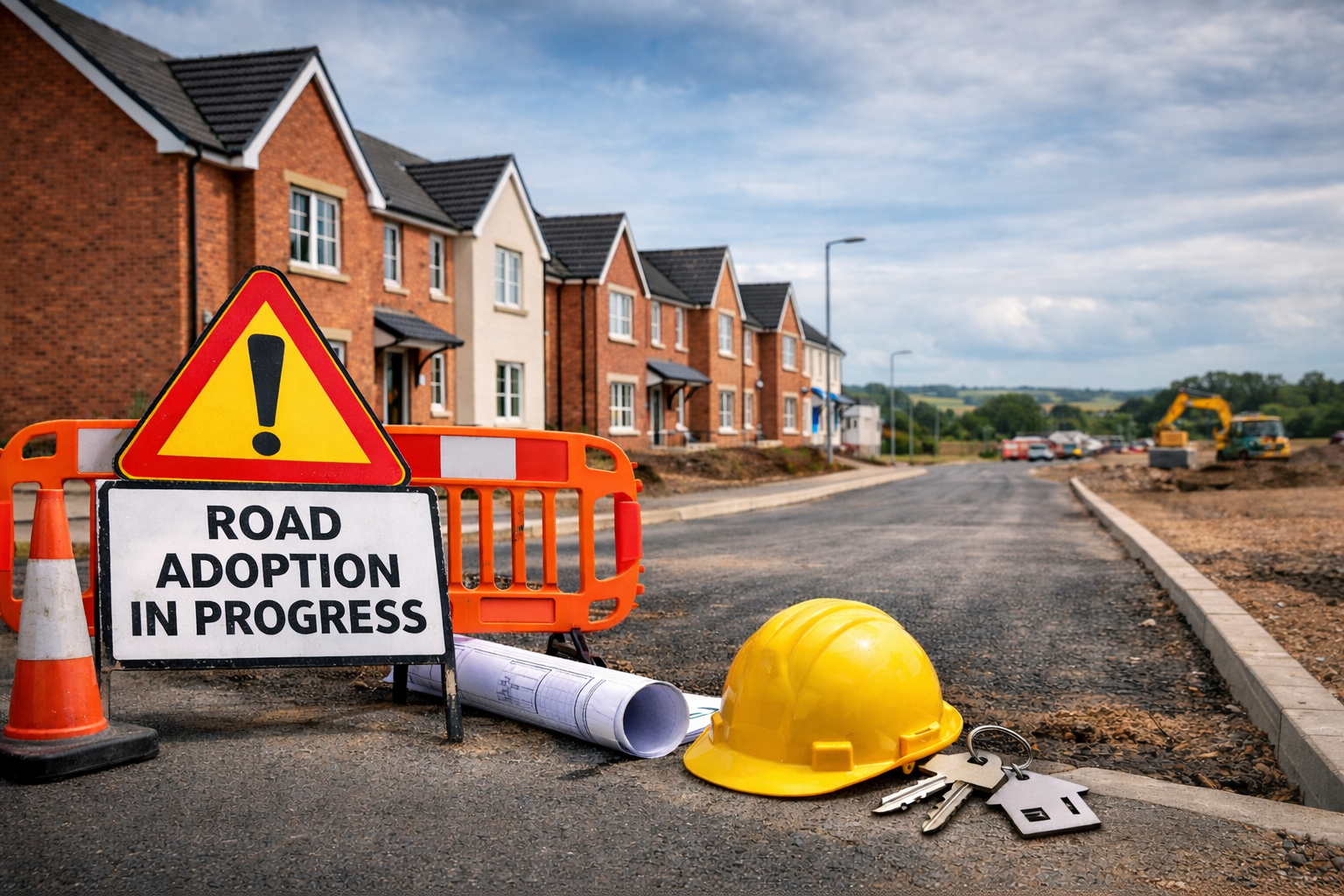
Across Northern Ireland there are thousands of properties located within housing developments where the estate roads have not yet been formally adopted by the public authority responsible for maintaining them. These unadopted roads in Northern Ireland can create significant legal and practical issues for homeowners, particularly when they attempt to sell their property.
One of the key mechanisms designed to prevent these problems is the road bond system. Road bonds are a legal requirement placed on developers when constructing estate roads within new developments.
At Lacey Solicitors Belfast, we regularly advise homeowners, buyers and developers on the legal framework surrounding road bonds in Northern Ireland, the adoption of estate roads and the legal difficulties that can arise where developments remain unfinished.
This article explains how the system works, the relevant legislation, and what homeowners need to know.
What Is a Road Bond in Northern Ireland?
A road bond in Northern Ireland is a financial guarantee provided by a developer to ensure that estate roads within a housing development are constructed to the required statutory standard.
The bond is required before construction begins and forms part of a Private Streets Agreement entered into between the developer and DfI Roads (Department for Infrastructure).
The purpose of the bond is simple:
- to ensure roads and footpaths are completed properly
- to protect the public authority if a developer fails
- to provide funds for completing infrastructure where necessary
If the developer fails to complete the road works, DfI Roads may call in the bond and use those funds to complete the infrastructure to an adoptable standard.
The Legal Framework for Road Bonds in Northern Ireland
The road bond regime is governed by several key pieces of Northern Ireland legislation.
The Private Streets (Northern Ireland) Order 1980
The primary legislation is the Private Streets (Northern Ireland) Order 1980, which governs the construction and adoption of new streets within developments.
Under Article 24 of the Order, developers must make prior provision for the expenses of street works before construction begins.
You can view the legislation here:
https://www.legislation.gov.uk/nisi/1992/3203
This requirement typically involves:
- entering into a Private Streets Agreement with DfI Roads
- lodging a road bond as financial security
- constructing the roads to the required statutory standard
The Private Streets (Construction) Regulations (Northern Ireland) 1994
The technical standards for estate road construction are contained within the Private Streets (Construction) Regulations (Northern Ireland) 1994.
These regulations govern matters such as:
- carriageway construction
- footways and kerbing
- drainage systems
- road layouts
Developers must comply with these standards before roads will be adopted.
Department for Infrastructure Guidance
Detailed operational guidance for developers is issued by DfI Roads, including the document:
This guidance explains that developers must enter into a Private Streets Agreement with DfI Roads prior to construction, and that this agreement is secured by a road bond which may be used by the Department to complete the road works if the developer defaults.
The Private Streets Agreement and Road Bond Process
Where planning permission includes a Private Streets Determination, developers must follow a formal process before construction begins.
DfI Roads requires developers to provide various documentation before preparing the agreement, including:
- Land Registry folios and maps showing ownership of the development land
- confirmation of the developer’s registered details
- details of the bank or insurer acting as bond surety
- building control approvals
- drainage agreements with Northern Ireland Water
- road layout plans and street lighting designs
Once completed, the Private Streets Agreement is sealed and registered as a statutory charge, giving the Department legal protection if the works are not completed.
Road Bond Reductions During Construction
Road bonds are usually reduced progressively as infrastructure works are completed.
DfI Roads typically considers reductions at three stages.
50% Bond Reduction
This stage normally requires:
- carriageways constructed to binder course level
- kerbing completed
- footways constructed
- preliminary sewer certificates from Northern Ireland Water
- approved street lighting designs
90% Bond Reduction
At this stage:
- the street must have been constructed in accordance with the determination
- construction works must be substantially complete
- technical approvals must be granted
100% Bond Reduction
The final stage requires:
- the street to have been properly maintained for one year
- defects remedied
- final certificates from Northern Ireland Water
- submission of as-constructed drawings
The key principle is that sufficient bond must remain available to complete any outstanding works.
Who Owns the Road Bond?
A road bond in Northern Ireland is not owned by the developer or by the homeowners within the development.
Instead, the bond is a financial guarantee held for the benefit of DfI Roads.
The bond is put in place by the developer at the outset of the scheme, usually through a bank or insurance company acting as surety. Its purpose is to ensure that DfI Roads has access to funds to complete or remedy street works if the developer fails, becomes insolvent or does not bring the roads up to an adoptable standard.
When the developer completes the works satisfactorily, the bond may be reduced and ultimately released by DfI Roads.
If the developer fails to complete the infrastructure, DfI Roads may call in the bond and use those funds to complete the road works.
Importantly, the bond remains under the control of the Department and does not transfer as an asset to homeowners or to a new developer who later acquires the site.
What Happens if a Developer Goes Into Liquidation?
Problems can arise where a developer responsible for constructing estate roads enters liquidation before the infrastructure is completed.
Under the Private Streets (Northern Ireland) Order 1980, the original developer remains responsible for completing the roads to an adoptable standard.
Where the developer fails or becomes insolvent, DfI Roads may draw down the road bond to fund completion of the works.
However, practical difficulties can arise where the bond value is insufficient to cover the cost of completing the roads.
This has occurred in some developments where older bonds were set at levels that no longer reflect the true cost of bringing infrastructure up to adoption standard.
Where this happens, developments may remain unadopted for extended periods, leaving homeowners facing uncertainty over road maintenance and property sales.
What Happens if Another Developer Takes Over the Site?
Where a development changes ownership following insolvency, the new developer does not automatically inherit the legal obligations of the original developer.
Instead, the incoming developer must normally:
- enter into a new Private Streets Agreement with DfI Roads
- provide a new road bond
- complete any outstanding road works
DfI Roads will not adopt the roads until the statutory standards are satisfied, regardless of who owns the site.
A new developer may choose to complete unfinished works, but they are not legally obliged to do so unless they enter into a new agreement with the Department.
New Enforcement Powers Introduced in 2025
Recent changes to departmental policy aim to address the long-standing problem of unadopted roads in Northern Ireland.
DfI Roads has indicated that from October 2025 enforcement action may be taken two years after a development reaches approximately 80% occupancy where road infrastructure has not been completed.
Importantly, road adoption can proceed independently of sewer adoption by Northern Ireland Water.
This policy is designed to prevent developments remaining unadopted indefinitely.
Why Road Bonds Matter for Property Buyers
For anyone purchasing property within a new development, the existence of a properly structured road bond and Private Streets Agreement is extremely important.
Your solicitor should always investigate:
- whether estate roads have been adopted
- whether a road bond is in place
- whether the development is progressing toward adoption
- whether any enforcement issues exist
Failure to properly investigate these issues can create serious difficulties when attempting to sell the property later.
Can You Sell a House on an Unadopted Road in Northern Ireland?
Yes, it is generally possible to sell a property located on an unadopted road in Northern Ireland, but the position can be more complicated than selling a property on a publicly maintained road.
When acting for a purchaser, a solicitor will usually investigate:
-
whether the road has been adopted by DfI Roads
-
whether a Private Streets Agreement and road bond are in place
-
whether the development is progressing toward adoption
-
whether any enforcement action or outstanding works remain
Mortgage lenders may require confirmation that a road bond or adoption mechanism exists, as this provides reassurance that the estate roads will eventually be completed and maintained at public expense.
If the roads remain unadopted and no bond or adoption process exists, lenders may be reluctant to lend and prospective purchasers may withdraw from the transaction.
For this reason, issues relating to road bonds and unadopted roads in Northern Ireland can sometimes affect the marketability and value of properties within certain developments.
Early legal advice can help identify these risks and allow buyers and sellers to make informed decisions before committing to a transaction.
Legal Advice on Unadopted Roads in Northern Ireland
The issue of unadopted roads in Northern Ireland continues to affect many homeowners and property buyers.
At Lacey Solicitors Belfast, our property and conveyancing team regularly advises clients on:
- conveyancing in new build developments
- road bond and adoption issues
- disputes involving unadopted roads
- property transactions affected by infrastructure issues
If you are purchasing a property within a development or experiencing difficulties arising from unadopted roads, our solicitors would be happy to assist.