
Farming Accidents in Northern Ireland
Farming is one of the most important industries in Northern Ireland, supporting rural communities and providing employment to thousands of people.
However, agriculture is also one of the most dangerous occupations in the region.
Every year farmers, agricultural workers, contractors and family members are injured in accidents involving livestock, machinery, falls from height and hazardous gases.
These incidents can cause life-changing injuries, long-term disability and significant financial hardship for farming families.
While some accidents are unavoidable, many occur because basic safety procedures were not followed or proper systems were not in place.
Where negligence is involved, injured individuals may be entitled to pursue a farm accident compensation claim.
Farming Safety Statistics in Northern Ireland
Farming consistently records a disproportionate number of workplace fatalities.
According to data from the Health and Safety Executive for Northern Ireland (HSENI) and the Farm Safety Partnership, agriculture continues to account for a significant proportion of work-related deaths.
Recent surveys show that:
- 1 in 10 farmers report a minor injury or near miss each year
- 2% of farmers report accidents requiring medical attention
- Nearly half of those injured suffer fractures
- 27% require more than 30 days off work
Northern Ireland has approximately 48,000 people working across almost 25,000 farms, yet agriculture accounts for a large share of serious workplace incidents.
This highlights the importance of improving safety standards across the sector.
The “Stop and Think SAFE” Farm Safety Campaign
To tackle the high number of agricultural accidents, the Farm Safety Partnership launched the fantastic “Stop and Think SAFE” campaign.
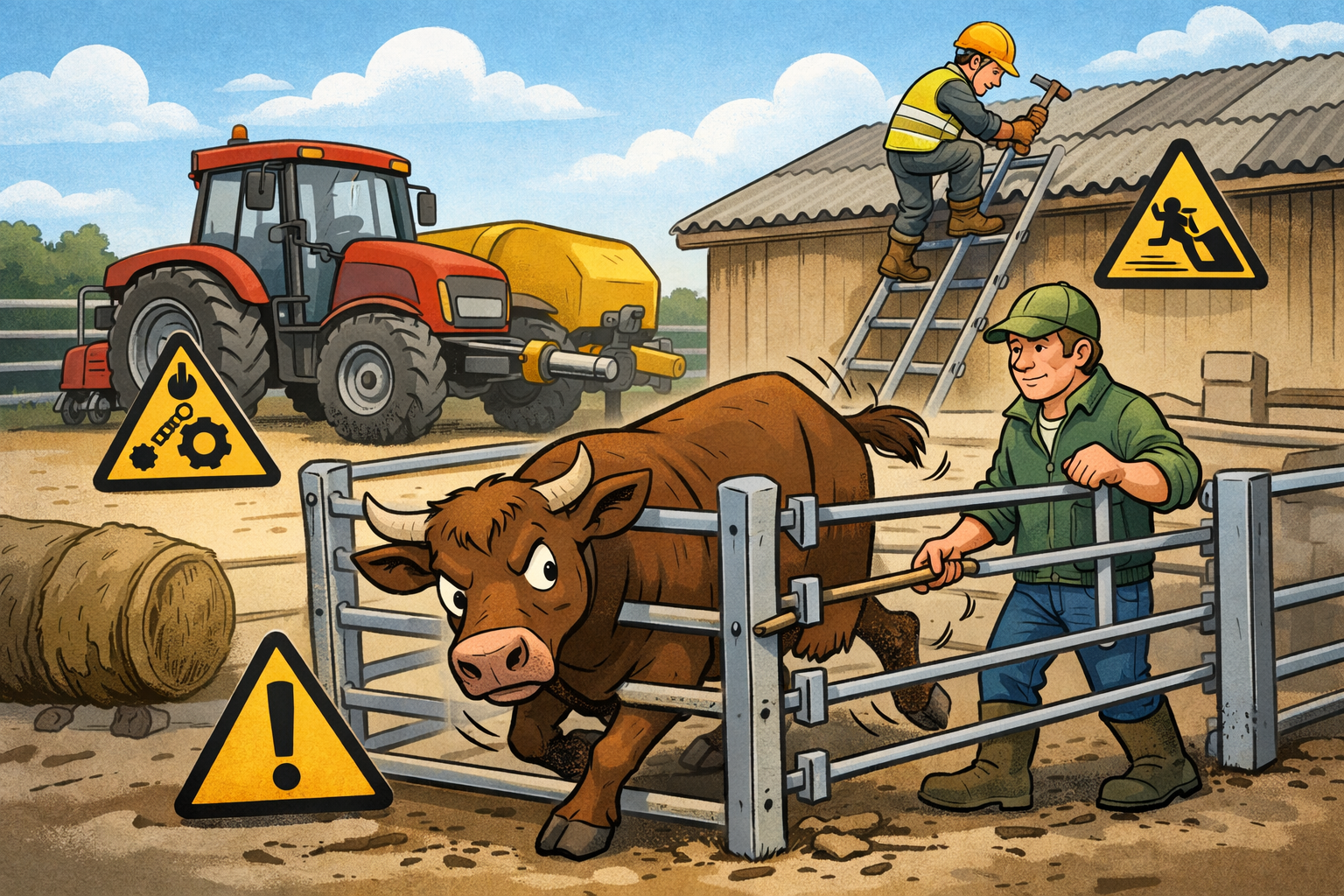
The SAFE message focuses on the four most common causes of serious farm accidents:
- Slurry
- Animals
- Falls
- Equipment
Understanding these risks is essential to preventing injuries on farms. Lacey Solicitors advises that these four areas provide a sensible starting point for any farmer or agricultural employer when carrying out appropriate health and safety checks and reviewing working practices on the farm.
Slurry Accidents and Toxic Gas Exposure
Slurry tanks are a routine part of modern farming but they also present one of the most serious hazards.
Slurry produces a mixture of gases including:
- methane
- carbon dioxide
- ammonia
- hydrogen sulphide
Hydrogen sulphide is particularly dangerous because it can be rapidly fatal to both humans and animals.
The highest risk occurs during slurry mixing, when gases are released into the surrounding air.
Safety guidance recommends:
- removing animals from sheds before mixing
- opening all doors and ventilation points
- keeping children away from the area
- mixing slurry on windy days where possible
Unfortunately, slurry incidents often involve multiple casualties, as people instinctively attempt to rescue others who have collapsed as seen in 2012 in NI when a tragic accident took the lives of three members of the same family. They were overcome with toxic fumes when trying to rescue one another.
Livestock Accidents on Farms
Working with animals will always involve some level of risk.
However, incidents involving livestock remain the most common cause of farm injuries.
According to farm safety and national reports both in Northern Ireland and the Republic of Ireland, livestock incidents account for approximately one third of reported farm accidents.
High-risk situations include:
- handling bulls
- dealing with freshly calved cows
- moving cattle through poorly designed handling systems
- working with animals that are unfamiliar with handlers
Even experienced farmers can suffer serious injuries when animals become frightened or agitated.
Good livestock handling facilities and proper planning are essential to reducing these risks.
Falls from Height on Farms
Falls are another leading cause of serious agricultural injuries and we have highlighted the issue in a previous article.
These accidents frequently occur during routine maintenance tasks such as:
- repairing barn roofs
- stacking bales
- cleaning gutters
- accessing loft spaces
Farm buildings often contain fragile roofing materials which can collapse without warning.
Working at height should always be carefully planned and appropriate equipment should be used.
Machinery and Farm Equipment Accidents
Modern agricultural machinery allows farms to operate efficiently and productively.
However, machinery is also involved in more than one third of fatal farm accidents.
Common causes of machinery accidents include:
- missing guards on power take-off (PTO) shafts
- poorly maintained tractors
- lack of visibility around vehicles
- attempting to repair machinery while it is still powered
These incidents can result in devastating injuries including:
- amputations
- crush injuries
- spinal injuries
- severe lacerations
Machinery accidents often require extensive medical treatment and rehabilitation.
Farm Safety and Children
Children living on farms are particularly vulnerable.
Because of their age and lack of experience, they may not fully understand the risks posed by animals, machinery and slurry tanks.
Safety guidance recommends that farms should have segregated play areas where children can play safely away from working machinery.
Sadly, many agricultural tragedies involve young family members who were simply playing near farmyards.
Common Injuries in Farm Accidents
Farm accidents frequently result in serious injuries because of the size of machinery and the unpredictable behaviour of animals.
Common injuries include:
- broken bones and fractures
- crush injuries
- amputations
- head and brain injuries
- spinal injuries
- severe lacerations
These injuries can prevent farmers or agricultural workers from returning to physical work.
For many farming families, the loss of one person’s labour can have a major financial impact on the farm business.
Can I Bring a Farm Accident Claim?
Many people assume that only farm employees can bring a legal claim following an accident.
In reality, a variety of people may be entitled to pursue compensation.
This may include:
- farm employees
- self-employed agricultural workers
- contractors
- visiting vets or professionals
- delivery drivers
- family members living on the farm
Each case will depend on the circumstances of the accident and who was responsible for maintaining safe conditions on the farm.
What Should You Do After a Farm Accident?
If you are injured in a farming accident, taking the right steps early can be important.
You should:
• seek medical attention immediately
• report the accident to the farm owner or employer
• record the details of the incident
• take photographs of the location or equipment involved
• obtain contact details for witnesses
Farm accident claims often involve complex investigations including machinery inspections, expert reports and witness evidence.
Early legal advice can help ensure that important evidence is preserved.
Farm Accident Compensation in Northern Ireland
If negligence can be established, an injured person may be entitled to claim compensation.
Compensation may include damages for:
- pain and suffering
- loss of earnings
- medical treatment
- rehabilitation costs
- care needs
- future financial losses
Serious injuries may have long-term consequences, particularly where they affect a person’s ability to work in agriculture.
Frequently Asked Questions About Farm Accident Claims
How long do I have to bring a farm accident claim?
In most cases, personal injury claims in Northern Ireland must be brought within three years of the accident.
Exceptions may apply where the injured person is a child or lacks capacity.
Can I claim if I was injured by livestock?
Yes.
Claims may arise where livestock injuries occur because of:
- unsafe handling facilities
- inadequate fencing or gates
- failure to properly control animals
- unsafe working practices
Can I claim if I am self-employed?
Yes.
Self-employed agricultural workers may still be entitled to compensation if the accident occurred because of unsafe working conditions on the farm.
What if the accident happened on a family farm?
Many people worry about bringing a claim against a family member.
In practice, claims are usually dealt with by farm insurance policies, meaning insurers handle the claim.
Farm Accident Solicitors in Northern Ireland
Investigating farm accidents often requires specialist knowledge of:
- agricultural machinery
- livestock handling practices
- workplace safety regulations
- HSENI guidance
Because these cases can involve complex circumstances, it is important to seek advice from solicitors experienced in serious personal injury claims.
Conclusion
Farming will always involve risk, but many serious accidents are preventable.
Campaigns such as Stop and Think SAFE and online learning tools such as www.farmsafenet.org highlight the importance of safety when working with slurry, animals, heights and machinery.
When accidents do occur, they can have devastating consequences for farming families and rural communities.
Understanding the risks and the legal rights of those injured is an important step in improving safety across Northern Ireland’s agricultural sector.