
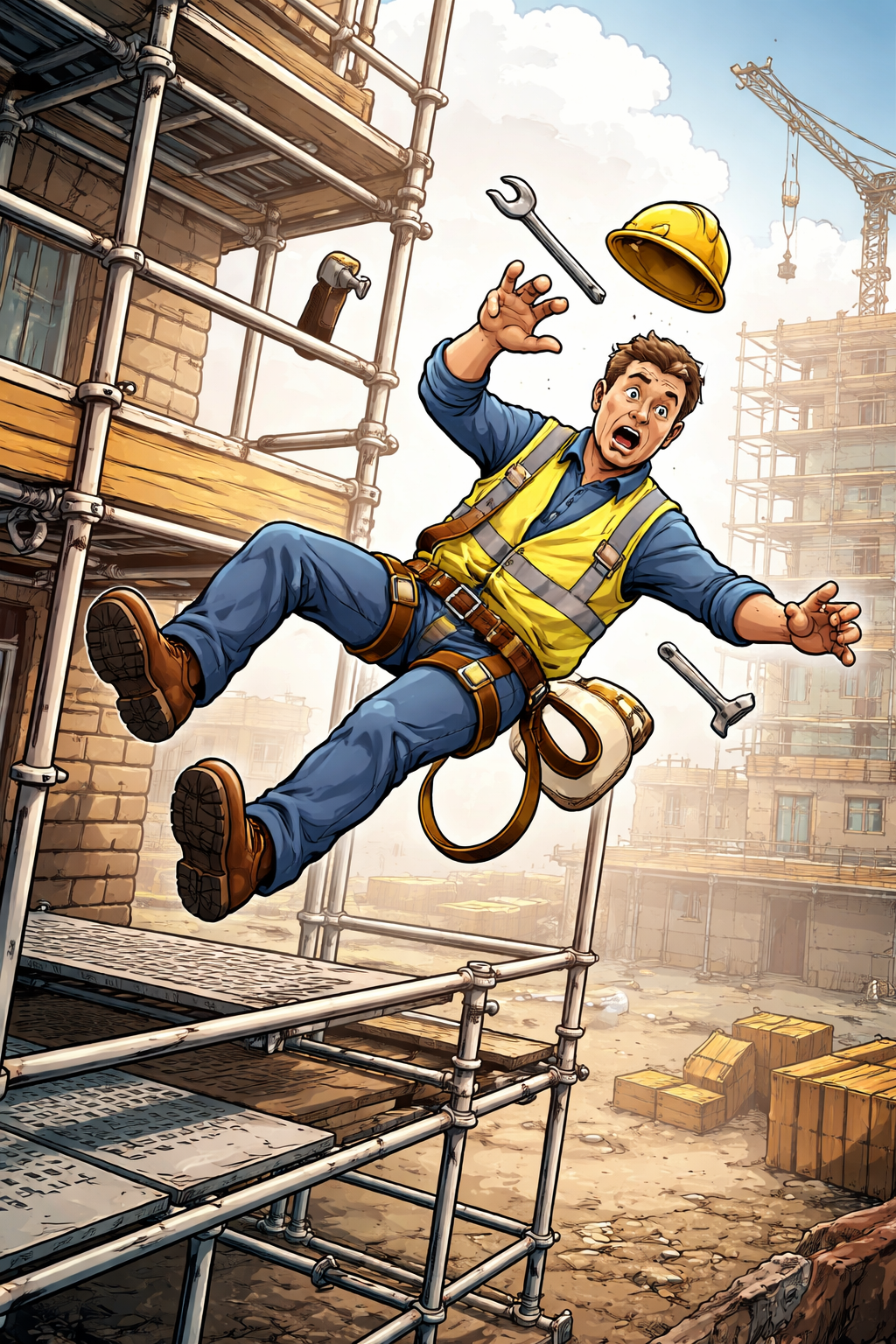
Falls from height remain one of the most serious causes of workplace injury in Northern Ireland. Employees working in construction, agriculture, manufacturing, maintenance and industrial environments are frequently required to work at height using ladders, scaffolding, roofs or elevated platforms.
Where appropriate safety systems are not properly implemented, the consequences can be severe and sometimes life-changing.
Under Northern Ireland law, employers have important duties to protect workers who carry out tasks at height. Where those duties are breached and a worker suffers injury, the circumstances may give rise to a workplace accident claim.
This article explains:
- The legal framework governing working at height in Northern Ireland
- The most common causes of fall-from-height accidents
- The types of injuries that can arise
- When an employer may be legally liable
What Is a Working at Height Accident?
A working at height accident occurs when a worker falls from a ladder, scaffolding, roof, platform or other elevated surface while carrying out their job. These accidents are one of the leading causes of serious workplace injuries in Northern Ireland and often arise where appropriate safety equipment, supervision or risk assessments were not in place.
Workplace Accident Statistics in Northern Ireland
Workplace accident statistics highlight the seriousness of working at height risks.
Figures published by the Health and Safety Executive for Northern Ireland (HSENI) indicate that:
- There were 19 workplace fatalities in Northern Ireland in 2021–2022
- The number fell to 10 fatalities in 2022–2023
- The majority of deaths occur in agriculture, construction and manufacturing
Falls from height remain one of the leading causes of fatal workplace accidents across these industries.
In the construction sector in particular, regulators consistently warn that working at height continues to present a high level of risk if appropriate safety precautions are not taken.
These figures demonstrate why employers must take working at height safety extremely seriously.
The Legal Framework for Working at Height in Northern Ireland
Employers in Northern Ireland owe a statutory duty to ensure the health and safety of their employees.
The primary legislation governing workplace safety is the:
This legislation requires employers to ensure, so far as reasonably practicable, the health, safety and welfare of employees while at work.
More specific duties relating to working at height are contained in the:
Under these regulations, employers must ensure that work at height is:
- Properly planned and organised
- Appropriately supervised
- Carried out by competent workers
- Supported by suitable and properly maintained equipment
- Subject to a suitable and sufficient risk assessment
Employers are also required to follow a recognised hierarchy of safety measures, including:
- Avoiding work at height where possible
- Preventing falls through collective protection (such as guardrails or scaffolding)
- Minimising consequences using fall-arrest systems or personal protective equipment
What Counts as Working at Height?
Many people assume that working at height only refers to high-rise construction work. In reality, the legal definition is much broader.
A person is considered to be working at height if they are working in any place where a fall could cause personal injury.
Examples include:
- Working on scaffolding
- Using ladders or step ladders
- Carrying out roof repairs
- Working on mezzanine floors or raised platforms
- Using cherry pickers or scissor lifts
- Working near unprotected edges
Importantly, even relatively low falls can cause serious injuries.
Common Causes of Falls from Height at Work
Many workplace accidents involving falls from height occur because basic safety procedures have not been followed.
Common causes include:
- Unsafe or defective ladders
- Poorly erected scaffolding
- Lack of guardrails or edge protection
- Failure to provide safety harnesses or fall-arrest systems
- Inadequate training or supervision
- Failure to carry out appropriate risk assessments
- Slippery or unstable working surfaces
In many accident investigations it becomes clear that the accident could have been prevented if appropriate safety systems had been implemented.
Serious Injuries Caused by Falls from Height
Falls from height frequently result in serious injuries due to the forces involved in the fall.
Common injuries include:
- Traumatic brain injuries
- Spinal cord injuries
- Pelvic fractures
- Complex limb fractures
- Internal organ damage
These injuries often require long-term treatment, rehabilitation and ongoing medical support. Our office recent deal with a case involving a construction worker who fell from a scaffolding and suffered complex injuries.
In more serious cases, a worker may be unable to return to their previous employment.
When Is an Employer Liable for a Workplace Accident?
Employers may be legally liable for a workplace accident if they have failed to take reasonable steps to protect employees from foreseeable risks.
Examples may include:
- Failure to provide safe access equipment
- Failure to install guardrails or edge protection
- Poor maintenance of scaffolding or ladders
- Failure to carry out appropriate risk assessments
- Lack of training or supervision
Where an employer breaches health and safety duties and an injury results, this may form the basis of a claim for workplace injury compensation.
Bringing a Fall from Height Compensation Claim
If you have been injured in a workplace accident in Northern Ireland, you may be entitled to pursue a compensation claim.
Compensation may include damages for:
- Pain and suffering
- Loss of earnings
- Future loss of income
- Medical treatment
- Rehabilitation costs
- Care and assistance needs
Serious accident at work claims often require detailed medical evidence together with expert analysis of future financial losses.
For this reason, it is important to obtain advice from solicitors experienced in workplace injury litigation.
Frequently Asked Questions
How long do I have to bring an accident at work claim in Northern Ireland?
In most cases, a person has three years from the date of the accident to issue court proceedings for personal injury.
Can I claim compensation if I fell from a ladder at work?
Possibly. If the accident occurred because of unsafe equipment, lack of training, or inadequate safety procedures, there may be grounds for a claim.
What if I was partly responsible for the accident?
Even where a worker may have contributed to the accident, compensation may still be recoverable, although the award may be reduced to reflect contributory negligence.
Conclusion
Working at height remains one of the most dangerous activities carried out in workplaces across Northern Ireland.
Despite clear legal duties designed to protect workers, falls from height continue to cause serious injuries and fatalities each year.
Where safety procedures are ignored or inadequate, the consequences can be devastating for workers and their families.
Anyone injured in a workplace accident should consider obtaining legal advice in order to understand their rights and whether compensation may be available.