
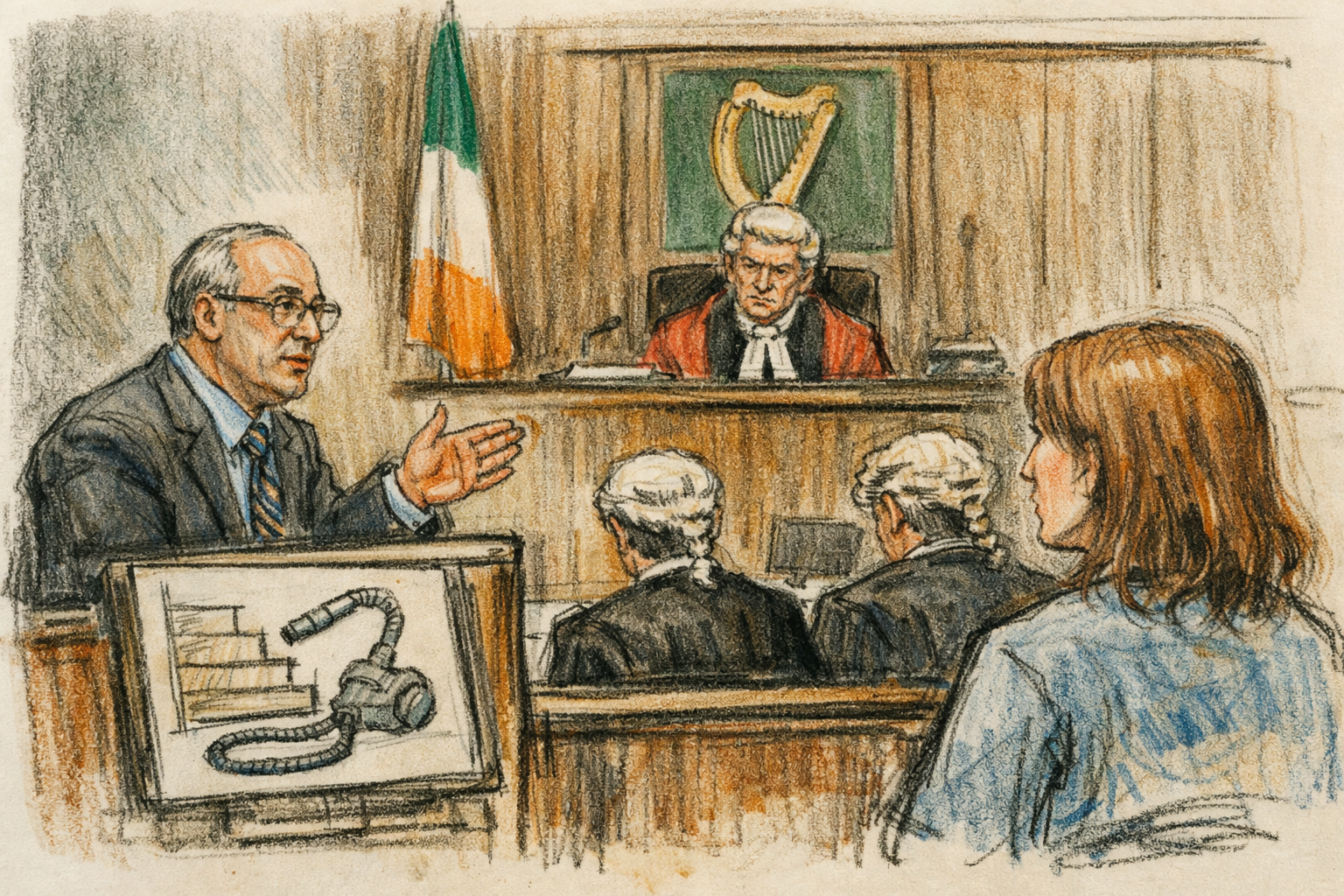
A recent High Court decision will be of considerable interest to insurers and injury practitioners dealing with employer liability claims in Ireland. In Sharon Walsh v Juniper Orthodontics Limited, the High Court dismissed a personal injuries action brought by a dental assistant who alleged she was injured after tripping on the hose of a vacuum cleaner while cleaning stairs at her workplace.
Delivering judgment, Mr Justice Anthony Barr emphasised an important principle that frequently arises in workplace accident litigation: the law requires employers to act reasonably, not perfectly. As the Court made clear, employers are not required to eliminate every conceivable risk that might arise during ordinary workplace activities.
The decision provides useful guidance for insurers defending employer liability claims and illustrates how courts continue to distinguish between an unfortunate accident and actionable negligence.
Background to the Claim
The plaintiff, aged 54, had worked as a dental assistant in a small orthodontic practice since 2007.
The accident occurred on 20 June 2016 at approximately 3pm while the plaintiff was vacuum cleaning a flight of stairs during a gap in the clinic’s patient schedule. As was common practice during quieter periods, staff members would carry out light cleaning duties when no patients were being treated.
According to the plaintiff, she switched off the vacuum cleaner and left it at the bottom of the stairs with the rigid arm resting against the banister. She then went upstairs to check whether the receptionist was on the telephone, as the noise of the vacuum cleaner could interfere with phone conversations.
While she was waiting upstairs, she alleged that the rigid arm of the vacuum cleaner fell over, causing the flexible hose to lie across one of the steps. When she returned and descended the stairs, she stepped onto the hose, lost her balance and sustained an inversion injury to her right ankle.
Medical investigations later revealed that the plaintiff had suffered an avulsion fracture of the distal fibula together with ligament damage to the ankle.
Delay in Notification
One feature of the case which will be familiar to insurers was the significant delay in notification of the claim.
Although the alleged accident occurred in June 2016, the employer gave evidence that he did not receive notification of the circumstances of the incident until a solicitor’s letter issued almost two years later in April 2018. By that stage, the clinic’s internal CCTV system had already overwritten any recordings from the relevant period.
This accident occured in 2016, almost two years prior to the amendment of section 8 of the Civil Liability and Courts Act 2004, which now requires a plaintiff in a personal injuries action to serve a letter of claim within one month of the cause of action.
The provision obliges the court to consider drawing appropriate inferences and, where the interests of justice so require, making costs consequences where this requirement is not complied with. For defendants and insurers, the legislative framework underscores the importance of prompt notification so that incidents can be investigated while contemporaneous evidence remains available.
Alleged Unsafe System of Work
The plaintiff alleged that the employer had failed to provide a safe system of work.
Engineering evidence was called on her behalf suggesting that the cleaning process was unsafe because the person vacuuming the stairs had to stop the hoover periodically and check whether the receptionist was on the telephone.
The plaintiff’s expert suggested a number of alternative safety measures, including:
- Carrying out cleaning outside working hours
- Installing a warning light system connected to the reception desk
- Soundproofing the reception area
However, the court ultimately rejected the suggestion that these measures were necessary or required under the law.
The Court’s Findings
The High Court concluded that the incident was simply an unfortunate accident rather than the result of negligence.
Mr Justice Barr stated:
“That was a very unfortunate accident. But that is all it was. It was an accident.”
The court observed that interruptions while vacuum cleaning stairs are entirely ordinary. People frequently stop such tasks to answer a phone, attend to someone upstairs or deal with another task.
The judge stated:
“Every day up and down the country, when people are carrying out vacuum cleaning operations on a flight of stairs… the person doing the vacuum cleaning may have to stop for any number of reasons.”
Importantly, the court accepted that the vacuum cleaner arm falling over was simply something that can occur without negligence on anyone’s part.
As Mr Justice Barr explained:
“From time to time when the rigid arm of a hoover is left propped in an upright position, it will sometimes topple over and come to rest on the ground. That is not anybody’s fault, it just happens from time to time.”
Reasonableness – Not Risk Elimination
As always, hindsight is 20/20, but in this case, the court was quick to reject evidence advanced by the Plaintiff’s engineer of steps that should have been taken to eliminate risk.
Addressing the suggestions made by the plaintiff’s expert engineer, the court stated:
“It is always possible to come up with steps that can be taken to eradicate any possible accident. However, that is not the duty that is placed on an employer… An employer is only required to take reasonable steps to prevent an accident that is reasonably foreseeable.”
This statement provides a clear reminder that the legal standard is reasonableness, not the elimination of every conceivable hazard.
Conclusion
For insurers and defence practitioners, the decision reinforces several familiar but important principles:
Not every workplace accident creates liability
The courts recognise that accidents can occur even where a workplace is reasonably operated.
Reasonable systems of work remain the legal standard
Employers are required to take reasonable precautions, not eliminate all possible risks.
Expert hindsight will not necessarily establish negligence
Courts remain cautious about retrospective suggestions that theoretically safer systems could have been implemented.
Early notification of incidents remains critical
Delays in notification may result in the loss of important evidence, including CCTV or witness recollection.
The High Court’s decision in Sharon Walsh v Juniper Orthodontics Limited serves as a useful reminder that not every workplace accident will give rise to legal liability.
Where an employer has implemented a reasonable system of work and the incident arises from an ordinary everyday activity, the courts will not impose liability simply because an injury occurred.
The phrase “where there is blame, there is a claim” is an oft repeated mantra in personal injury litigation. This judgment however is a reminder that while accidents may happen, liability does not follow the same – negligence must still be proven to sustain the claim.